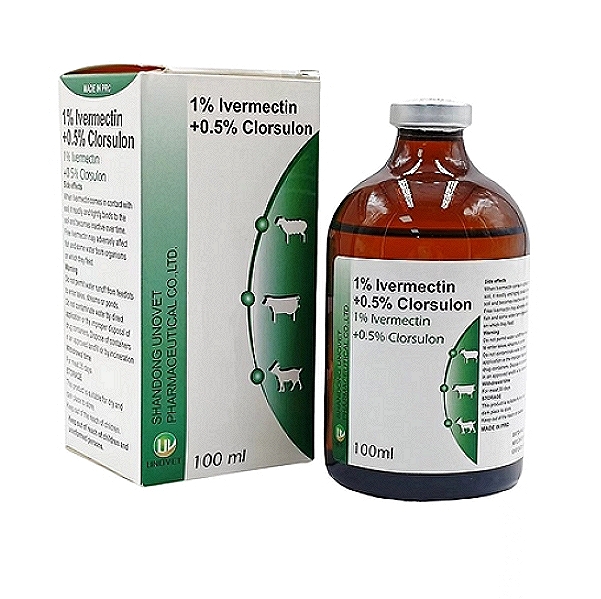
Ivermectin is a broad-spectrum antiparasitic used in cattle and swine to control various internal and external parasites. A CODEX and WVA Veterinary Medicine.
Ivermectin is indicated for the treatment and control of internal and external parasites in cattle, swine, sheep, and reindeer.
INDICATIONS
Cattle: Effective against gastrointestinal roundworms (adults and 4th-stage larvae), lungworms (Dictyocaulus viviparus), cattle grubs (Hypoderma species), sucking lice (Linognathus vituli), and mange mites (Psoroptes ovis and Sarcoptes scabiei).
Swine: Indicated for gastrointestinal roundworms (large roundworm, red stomach worm, nodular worm), lungworms (Metastrongylus species), lice (Haematopinus suis), and mange mites.
Sheep: Used for internal parasites, including gastrointestinal roundworms, lungworms, and nasal bots.
ADMINISTRATION
Cattle: Inject under the loose skin either in front of or behind the shoulder.
Dosage: Typically 1 mL per 110 lb (50 kg) of body weight.
Needle Size: A 16-gauge, 1/2 to 3/4 inch needle is commonly suggested.
Volume Limit: No more than 10 mL should be injected into a single site; larger doses should be divided between different locations.
Swine (Pigs): Inject subcutaneously in the neck, specifically immediately behind the ear.
Dosage: Typically 1 mL per 75 lb (33 kg) of body weight.
Needle Size: Use a 16- or 18-gauge needle for adults (sows/boars) and an 18- or 20-gauge needle for young pigs.
Sheep: Inject under the loose skin behind the shoulder. In woolly sheep, ensure the needle fully penetrates the wool and skin before delivering the dose.