
USD
  • Dollar (USD)
  • Euro (EUR)

Lidocaine

Home/L/Lidocaine

Lidocaine

In Stock

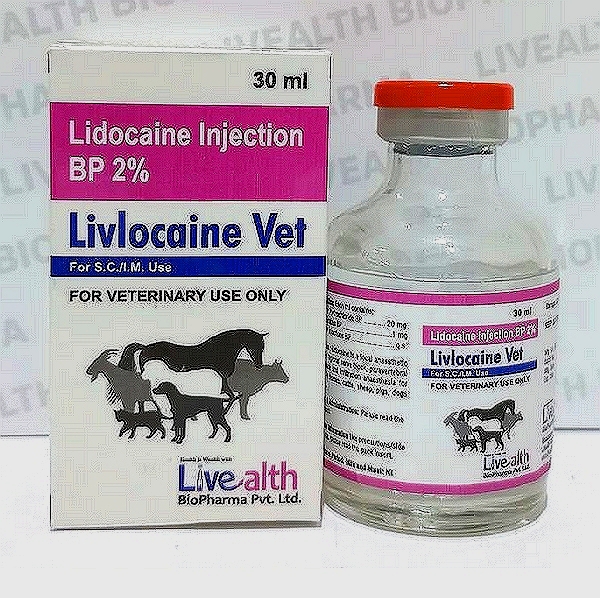
Lidocaine Injection

Lidocaine a local anesthetic, and as an antiarrhythmic agent used in cattle, horses, swine, goats and sheep, prior to surgery for low and high epidural anaesthesia (cattle), local-regional anaesthesia (horses), epidural and intercostal anaesthesia (swine) and epidural anaesthesia (sheep, goats).

Lidocaine injection is indicated for local and regional anesthesia during surgical and diagnostic procedures, and for the management of pain and certain cardiac arrhythmias in various animal species.

INDICATIONS

  • Infiltration anesthesia: Injecting the solution directly into the tissue at the site of a minor surgery or wound to numb the immediate area.
  • Nerve blocks: Injecting near specific nerves (e.g., dental blocks, brachial plexus) to desensitize a larger region of the body for procedures like dental extractions or limb surgeries.
  • Epidural/Spinal anesthesia: Injecting into the epidural space (lumbar or caudal) to provide pain relief and anesthesia for procedures involving the caudal abdomen, pelvis, or hind limbs. 

ADMINISTRATION

  • Local Infiltration (Line Blocks/Field Blocks): Lidocaine is injected subcutaneously (under the skin) along the planned incision site to numb the immediate area.
    • Technique: The anesthetic is injected slowly as the needle is withdrawn to distribute it throughout the tissue. This creates a “line block” or “field block” for minor procedures.
    • Concentration: A 0.5% concentration is often used, sometimes diluted from a 2% solution.
  • Nerve Blocks: A more targeted approach where lidocaine is injected near specific nerves to desensitize a larger region of the body, such as a limb or part of the head (e.g., dental blocks, cornual blocks for dehorning).
    • Technique: The needle is guided to the vicinity of the nerve using anatomical landmarks or nerve stimulators. Aspiration is crucial before injection to prevent accidental intravascular administration.
  • Epidural (Neuraxial) Injection: Lidocaine is injected into the epidural space around the spinal nerves, typically in the lumbosacral or sacrococcygeal region. This provides regional anesthesia for the caudal abdomen, hind limbs, and perineum.
    • Technique: The “hanging drop technique” is often used to confirm correct needle placement in the negative-pressure epidural space. The drug is administered slowly to avoid excessive cranial spread, which can cause complications like hypotension.
  • Intravenous (IV) Administration: This method is used for systemic analgesia (pain control throughout the body), especially during and after surgery, and to treat certain types of abnormal heart rhythms (ventricular arrhythmias).
    • Technique: It is typically administered as a slow initial bolus (loading dose) followed by a continuous rate infusion (CRI) using a syringe pump to ensure a steady and safe dose. Rapid IV injection can be toxic.. 
No shipping rates are available for this product.
Your Cart
0

Your cart is empty.

Return to Shop
Added to cart