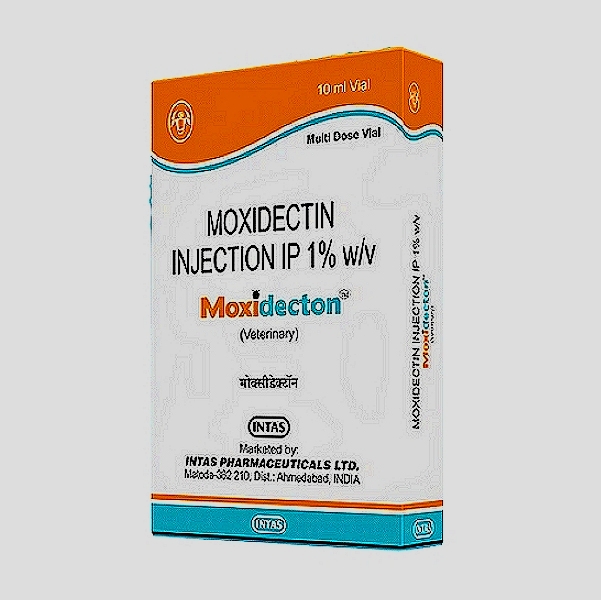
Intas Moxidecton (moxidectin) is an antiparasitic medication used to treat and prevent internal and external parasites, primarily in cattle, sheep, and dogs.
INDICATIONS
for Cattle
- Gastrointestinal Roundworms: Effective against adults and L4 larvae of species such as Ostertagia ostertagi, Haemonchus placei, Trichostrongylus axei, and Cooperia species.
- Lungworms: Controls Dictyocaulus viviparus (adults and L4 larvae).
- Cattle Grubs: Targets parasitic larvae of Hypoderma bovis and Hypoderma lineatum.
- Mites: Specifically indicated for psoroptic mange (Psoroptes ovis).
- Lice: Effective against sucking lice such as Linognathus vituli and Solenopotes capillatus.
- Persistent Activity: Provides protection from reinfection for up to 42 days for certain species like lungworms.
for Dogs
Administered as an extended-release injectable suspension with the following indications:
- Heartworm Prevention: Prevents heartworm disease caused by Dirofilaria immitis.
- Hookworm Treatment: Indicated for the treatment of existing larval and adult infections of Ancylostoma caninum and Uncinaria stenocephala present at the time of injection.
ADMINISTRATION
- Route: It is given as a subcutaneous injection, meaning under the loose skin.
- Injection Site (Cattle): Typically given in the left or right side of the neck or the loose skin in front of or behind the shoulder.
- Injection Site (Dogs): Determined by the vet.
- Dosing: The dosage is calculated based on the animal’s body weight to ensure effectiveness and safety.
- In Dogs: The sustained-release injection is primarily used for:
- Heartworm prevention: Provides protection for 6 or 12 months with a single dose.
- Hookworm treatment and control.
- Dogs must be tested for existing adult heartworm infection before receiving the injection, as using it in an infected dog can cause severe reactions.
- In Cattle and Sheep: It is used for the treatment and control of a wide range of parasites, including:
- Gastrointestinal roundworms (e.g., Ostertagia ostertagi, Haemonchus placei).
- Lungworms (Dictyocaulus viviparus).
- Cattle grubs (Hypoderma bovis, Hypoderma lineatum).
- Mites (Psoroptes ovis) and lice (Linognathus vituli, Solenopotes capillatus).
- It offers prolonged, persistent activity, protecting against reinfection for several weeks to months, depending on the parasite.