USD
  • Dollar (USD)
  • Euro (EUR)

Acepromazine

Home/A/Acepromazine

Acepromazine

In Stock

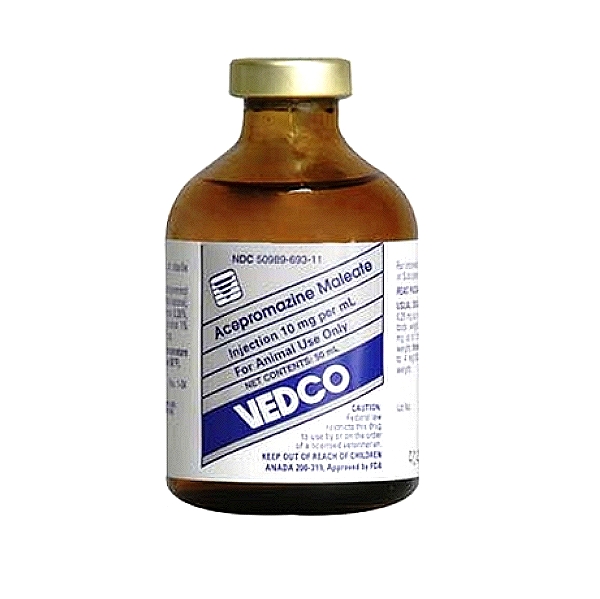
Acepromazine Maleate Injection

Acepromazine Maleate is a tranquilizer/sedative and pre-anesthetic agent used in dogs, cats, and horses. Depresses the CNS, causing sedation, and muscular relaxation. Calms animals during stressful events, like veterinary visits, grooming appointments, or travel. A WVA Veterinary Medicine.

Acepromazine maleate injection is indicated as a tranquilizer/sedative and a pre-anesthetic agent in dogs, cats, and horses.

INDICATIONS

  • Tranquilization and Restraint: To help control intractable or fractious animals during various procedures, including clinical examinations, treatments, grooming, sample collection (e.g., blood draws), X-rays, and minor surgical procedures.
  • Pre-anesthetic Agent: Used before major or minor surgery to produce sedation, muscle relaxation, and to reduce the required doses of general anesthetics, which enhances and prolongs their effects.
  • Adjunct to Local Anesthesia: Used in conjunction with local anesthesia for procedures such as castration, ocular surgery, or applying casts in horses.
DOGS & CATS
  • Restraint: Aids in controlling fractious (unmanageable) animals during examinations, treatments, grooming, X-rays, and minor surgical procedures.
  • Pre-anesthetic: Used before general anesthesia to enhance and prolong the effects of anesthetics, thereby reducing the required dosage of general anesthesia.
  • Anti-emetic: Helps control vomiting associated with motion sickness.
  • Anti-itching: Alleviates itching as a result of skin irritation (though more effective anti-itch medicines are available).
  • Behavioral Issues: Can be prescribed to control nervousness, excessive vocalization, and excitable behavior, particularly prior to potentially stressful events like veterinary visits. 
HORSES
  • Restraint and Transport: Aids in controlling nervous or fractious horses during examination, treatment, loading, and transportation.
  • Adjunct to Local Anesthesia: Particularly useful when used with local anesthesia for minor procedures like castration, neurectomy, or applying casts.
  • Laminitis: May be used off-label in the early treatment of laminitis due to its ability to dilate blood vessels and potentially improve circulation in the hoof.
  • Exertional Rhabdomyolysis: Sometimes used as a preventative or part of the treatment for “tying up” in horses (exertional rhabdomyolysis) due to its muscle relaxant and vasodilatory properties. 

ADMINISTRATION

  • Injection (Intravenous, Intramuscular, Subcutaneous): Injections are generally administered by a veterinarian in a hospital setting.
    • Intravenous (IV) injections should be administered slowly, allowing about 15 minutes for the full effect to be seen.
    • Intramuscular (IM) and subcutaneous (SC) injections are also common routes, with intramuscular injections sometimes causing a brief stinging sensation.
No shipping rates are available for this product.
Your Cart
0

Your cart is empty.

Return to Shop
Added to cart