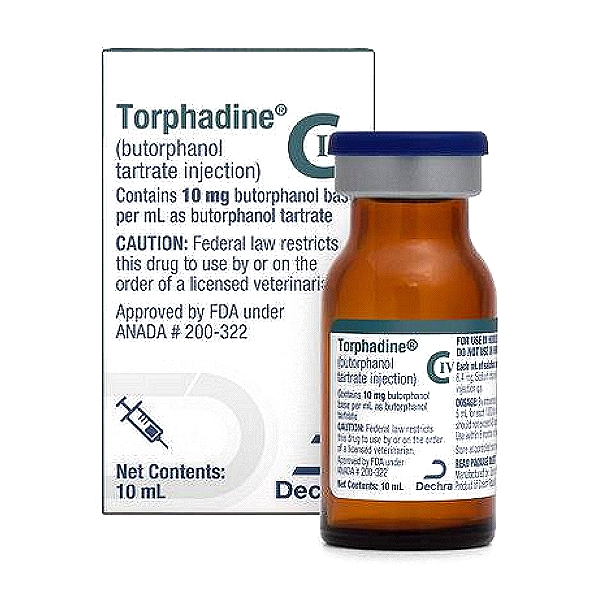
Dechra’s Torphadine (butorphanol) is used for its analgesic, sedative, and antitussive properties in dogs, cats and horses, as an adjunct to general anesthesia.
INDICATIONS
- Pain Relief: Butorphanol is effective for providing short-term relief of mild-to-moderate pain, particularly visceral pain (e.g., abdominal pain associated with colic in horses). Its effects typically last about 2-4 hours.
- Sedation: It is commonly used in combination with other drugs (such as alpha-2 agonists like dexmedetomidine or xylazine) to produce sedation or chemical restraint for minor procedures or examinations.
- Pre-anesthetic: Butorphanol can be administered before surgery as part of a balanced anesthetic protocol.
- Cough Suppressant: In dogs, it is FDA-approved and widely used as a potent antitussive (cough suppressant).
- Anti-vomiting Agent: It is sometimes used to prevent nausea and vomiting, including that associated with chemotherapy in some animals.
- Reversal Agent: Because of its mixed opioid agonist/antagonist properties, it can be used to partially reverse the side effects (like respiratory depression or excessive sedation) of stronger “pure” mu-opioid agonists (such as morphine or fentanyl), while still maintaining some level of pain relief.
ADMINISTRATION
- Intravenous (IV): Administered directly into a vein for immediate onset. This is the recommended route for horses to relieve colic pain and is also used in dogs and cats for rapid sedation or analgesia.
- Intramuscular (IM): Injected into a large muscle mass. Analgesic effects typically begin within 15 to 30 minutes.
- Subcutaneous (SC/SQ): Injected under the skin. This route is commonly used for cats and dogs, with peak concentration occurring roughly one hour after administration.
Species-Specific Protocols
- Horses: The standard dose is 0.1 mg/kg by intravenous injection. It is used to alleviate visceral pain from colic and can be repeated every 3–4 hours for up to 48 hours.
- Dogs: Administered via IV, IM, or SC injection at varying doses (e.g., ~0.1–0.4 mg/kg) for pain control, as an antitussive (cough suppressant), or as a pre-anesthetic.
- Cats: Frequently given via subcutaneous injection for pain relief (standard dose often 0.4 mg/kg).